
Hiking packs were once the reserve of socks and sandals-wearing walkers, but in recent years, Gorpcore (Good Ol’ Raisins and Peanuts) has brought a nouvelle vague of style to the outdoor industry.
Brands have heavily invested in the look, combining style with practicality that will take wearers from the club to the crag, and beyond. Berghaus is at the forefront of this fashion fusion, with Liam Gallagher famously raving about (and in) their products as far back as the 1990s.

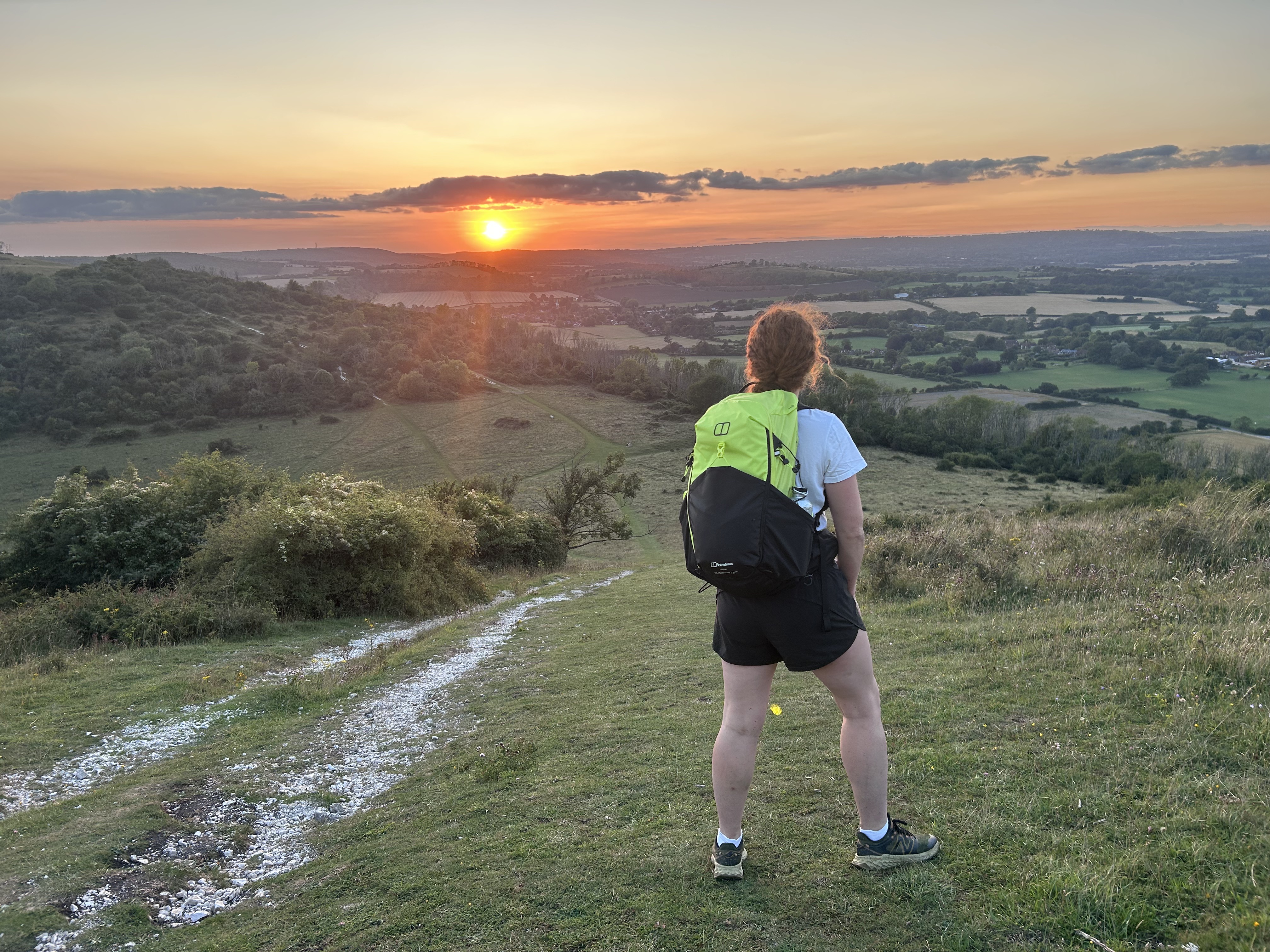
So it’s no surprise that many Berghaus products today feature a subtlety that warrants a double take. That’s certainly the case with the 3D Freeflow 30+5L, which upon first impressions, is more akin to a commuter carryall than to a bona fide mountain pack. In an eye-catching fluorescent yellow/black, its appearance is sleek, belying the practical features within.
Sphere score
For
- Adjustable back system is pretty nifty
- Chest and waist pockets are capacious enough for a phone, small water bottle and plenty of snacks.
- Expansion zip is useful when it comes to exploring further afield.
Against
- When on its smallest setting, the adjustable back system means the top of the backpack sits quite high and digs into my neck/catches a ponytail.
- The bright yellow isn’t for everyone – I prefer a more inconspicuous colour, such as the grey and blue colourways this bag also comes in.
- Due to the frame, it’s not the lightest of hiking packs, weighing in at 1408g.
Tech Specs
- £180
- One size
- 1408g Height 58cm, Width 29cm, Depth 24cm
What does the Berghaus Unisex 3D Freeflow 30 + 5 have to offer?
Actually, quite a lot. The Freeflow is all about back comfort, with airframe suspension keeping the pack off the back for efficient air flow, a 3D printed lumbar pad cushioning the lower back and a waist and chest strap allowing for a snug fit.
However, the standout feature is the adjustable back length – a relatively low faff way of fitting the pack to a variety of user heights, and achieved through a tidy internalised strap system. It takes no time at all and means that smaller wearers don’t have to choose between shoulder or hip fit.

When it comes to the storage itself, the 30-litre main compartment is ample for a water bladder (there’s a little strap which I assume is for this purpose), day’s snacks and wet/warm kit, with room to spare. Unzip the expansion section and you could just about squeeze a lightweight sleeping system and bivy bag in, while external loops and walking pole hoops allow for extra gubbins to be clipped on.
The top zip pocket is neatly velcroed to the back panel, rather than intruding into the main compartment, but my personal most used feature is the stuff pouch on the front of the Freeflow – perfect for that extra layer that you want quick access to on blustery autumnal days. In inclement conditions, the rain cover is quickly deployed from a Velcro pouch on the bottom of the bag, although I can’t yet vouch for its effectiveness.
Finally, while all of the materials seem pretty sturdy, if your pack suffers any damage on your adventures, rest assured that the Repairhaus team will fix it for free, proving you cover the postage.
Wearing – what is the Berghaus Unisex 3D Freeflow 30 + 5 like?
On initial impressions, the Freeflow is somewhat rigid and weighty – a far cry from the Big Agnes Sweetwater UL 28L that I tested recently. It also weighs almost twice as much. However, when you consider their different purposes and the features offered by the airframe suspension, this weight difference becomes negligible.

The Freeflow is designated a hiking pack, designed for comfort on long days rather than fast and furious ascents. And by all accounts, it does the job well, with subtle features such as the expansion pouch, full-length zip and adjustable back making it a practical option.
At 5ft7, I had the frame on the shortest of the three settings, and the waist strap almost at its tightest. Somewhat annoyingly, I found the very top of the frame dug into the back of my neck and caught my ponytail at points. Equally, the shoulder straps could do with being slightly narrower, for without the chest strap cinched tight, they dug into the tops of my biceps uncomfortably.
Thankfully, Berghaus now do a small frame variant of the Freeflow 30+5, which should correct any of these issues for slighter wearers. The width, depth and capacity remain the same, while the height is reduced from 58cm to 52cm, broadening the customer base to which this pack is available.
Slight sizing issues aside, once loaded up to roughly 15kg, the pack sat comfortably, the lumbar pad spreading weight across my lower back and reducing the strain on my shoulders. Movement was minimal, even when jogging down steep descents, and the deep side pockets meant that both water bottles stayed put, too.

On flatter terrain, the Freeflow was easy to forget about. The suspended back meant that sweat soon evaporated, with patches only building under the lumbar pad and shoulder straps on hotter days. The efficient weight distribution, meanwhile meant that I suffered no discomfort or rubbing even after several miles.
So far, I’ve covered less than 100 miles with the Freeflow, and the water-resistant material still feels as fresh as it did on day one. It’s still garishly bright, and has yet to show sign of discolouration, or any snags, despite having been placed down, dragged through bushes and chucked in the boot several times. However, Berghaus’ repair promise is a reassuring one, nonetheless.
To finish
In a market oversaturated by cool offerings, it’s often hard to narrow down a go-to pack, especially when Berghaus itself offers competing options. While the Freeflow does has its shortcomings, its comfort and subtle host of features make it stand out as an adaptable option to go from city to hill.


Leave a Reply